See what your AI edits affect.
The 126× context-size result compares a simulated graph-assisted grep loop. It does not measure total agent-session token savings. Read the measured results and limits.
Built for the humans and the agents editing the code
codeweb computes one structural graph and serves it two ways, so you and the agents editing your code share the same map.
An interactive map
One self-contained HTML report — the dependency web, duplication, hotspots, and ranked, cycle-safe consolidation. No CDN, no network, opens straight from disk.
28 deterministic tools
Over MCP, your agents ask what already does this, what an edit breaks, and which fix is safe — before they write a line. No LLM in the analysis loop, so answers don't drift.
A four-stage deterministic pipeline
Parse-free extraction on the fast path for JavaScript, TypeScript, Python, Rust, Go, Java, C#, Ruby, PHP, Kotlin, Swift, C, and C++, with an agent fallback for everything else.
extract
Parse-free atomic nodes + edges, per language.
cluster
Group nodes into semantic domains by call gravity.
overlap
Body-confirm cross-domain duplication and rank it.
render
A self-contained interactive map + 28 agent tools.
Your repo — and any repo you're considering
Map your own codebase
See the real dependency web, find where logic is duplicated, and get an ordered, cycle-safe plan to consolidate it.
Review before you adopt
Clone a third-party repo read-only, map its supported source, and get an adoption review before you commit to depending on it. codeweb never runs the target.
Every claim comes with its data
Tested against independent checkers. The failures are published alongside the wins.
126×
smaller context size than a simulated graph-assisted grep loop. This is a context-size comparison, not total agent-session token savings.
0 disagreements
across ~490,000 checks of codeweb's answers against independent implementations: who calls what, what an edit breaks, where the cycles are.
44% → 74%
of a function's callers found by AI agents: grep vs codeweb, same context budget, better in all 5 runs (v0.9.0 pilot).
Approachable at the surface, deep when you need it
For a new codebase, open the map, follow the foundations-first reading order, and inspect the domains. For work at scale, add the CI gate and give your agents all 28 MCP tools. codeweb supports graphs with more than 16,000 symbols.
- Beginners — one command, one map, plain-language findings.
- Advanced — deterministic tools, fitness rules, sharded subgraphs, a PR gate.
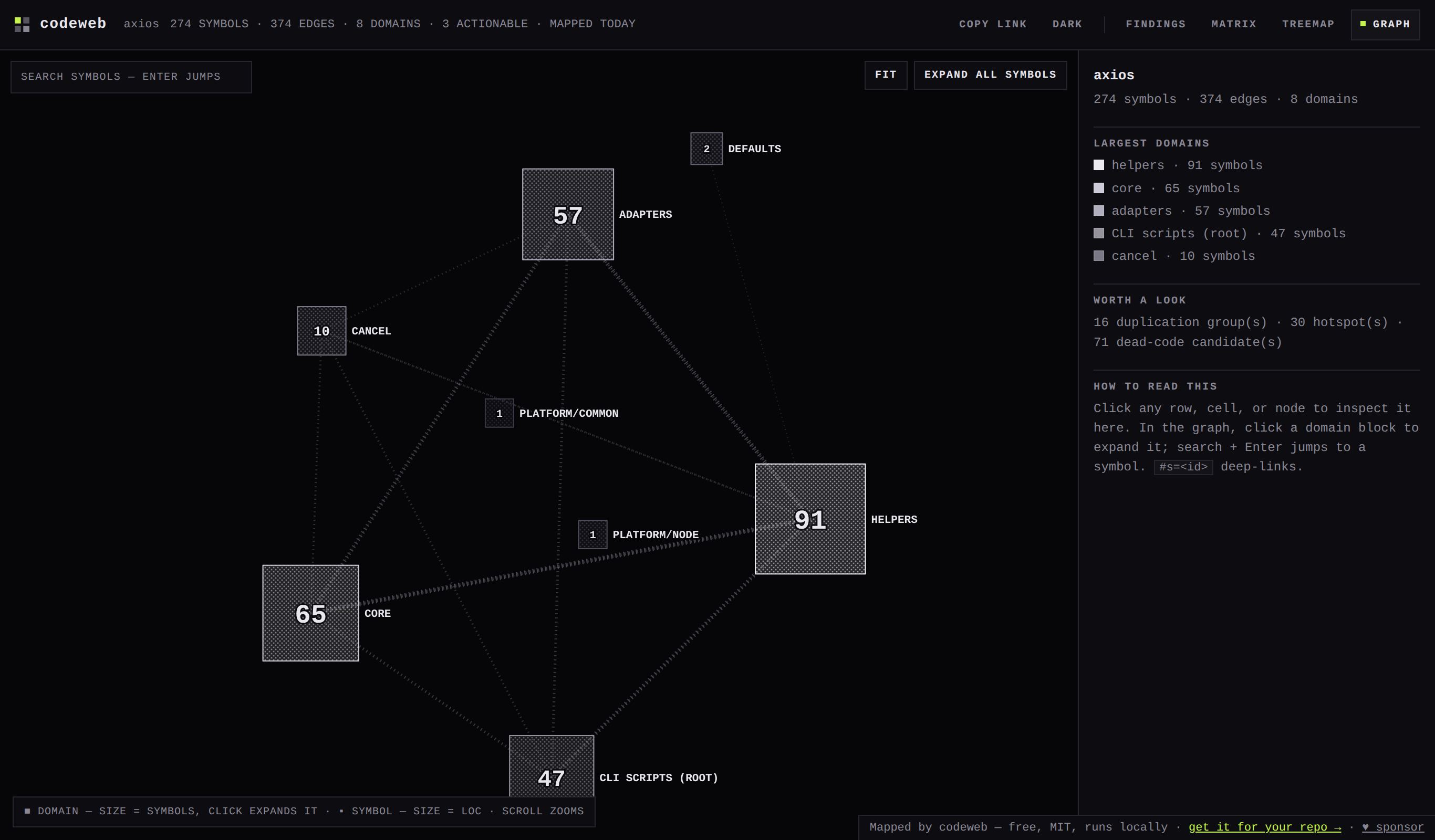
The live report — a real map of axios (280 symbols, 7 domains). Open the interactive demo →
Ship bigger changes with fewer surprises
You and your agents see the same map before any of you edits. You find the right code faster, and you break less of it. Every claim on this site is measured, and the failures are published too.
To receive release notes, select Watch → Custom → Releases on GitHub. Release notes are the only announcement channel.